Bulgarian Artillery Attack on the French Camp (1918)
The Reincarnationist PapersThe Bulgarian Artillery Attack on the French Camp (1918) turns a desperate night bombardment into a study of command under pressure: Captain Hoxa attempts to make a vulnerable artillery position into a weapon, while the storm, the river, and the approaching French infantry steadily close the space in which his guns can operate.
Strategic Setting and Preparation
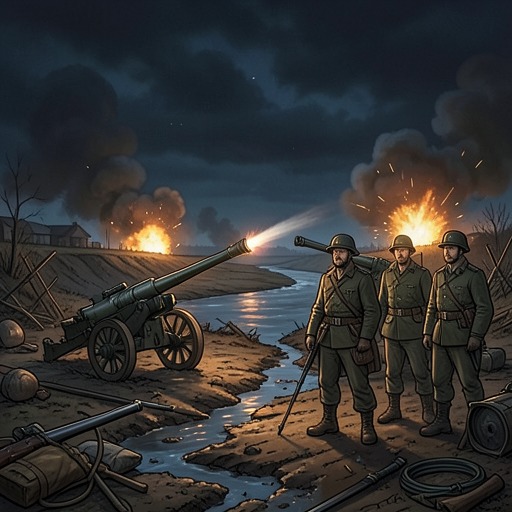
The action takes place on September 18 and 19, 1918, after the Bulgarian front has been retreating for three weeks. The Bulgarian artillery is stationed on the small triangle of land where the Cherna River flows into the Vardar River. Vasili Arda is no strategist, but he recognizes that the exposed ground is a poor place to hold, even for a single night. The unit has five Krupp 77 mm howitzers, and Vasili works in the autumn sun stacking 75-pound shells, each two feet long, in rows beside the gun emplacement. The guns face south toward Greece and the French divisions somewhere beyond the horizon.
The preparation is practical and repetitive: ammunition must be moved from the wagon to the guns, and the men complain that hauling it in and out each day keeps them from reaching Skopje. Hoxa orders all five crews to prepare their positions and camps within an hour. The horses are to be tied beside the river, and the men are allowed only one cooking fire, which must be extinguished before dark. His warning that two full-strength French divisions are sleeping in the valley makes concealment and discipline immediate necessities. Around Vasili, twenty-two tired, dirty men drink thin barley soup from metal cups as daylight falls. A storm approaches from the Gulf of Salonika, its last light visible along the southern edge of the valley.
Hoxa's Surprise Plan
As the men discuss the enemy camp, Hoxa turns the prospect of a French attack into an offensive plan of his own. He proposes striking by surprise when the rain begins, catching the French soldiers in their tents. When a corporal starts to object, Hoxa draws his revolver and points it at the man's face. His threat makes clear that the order is not open to debate. The plan is both an assault and an exercise in coercive command: even the danger of attacking a larger force is subordinated to Hoxa's demand for obedience.
Hoxa assigns the crews different tasks. Most are to begin with high-explosive ammunition, while Vasili's second squad and three other men prepare five white-phosphorus rounds. Those shells are meant to strike where the first two companies cannot see the French bivouac; their bright explosions will show the other artillery crews where to direct their own fire. The crews are to wait until the French campfires are nearly out and the soldiers are asleep. In the dark, the storm that threatens the Bulgarian position is also expected to cover the attack.
The Bombardment Begins
Hoxa waits astride the raised barrel of the third gun as lightning flashes behind the French camp. Thunder builds, rain begins to strike the guns and uniforms, and the company watches him for a signal. When the wind blows from the south and the storm lies directly over the French camp, Hoxa orders the guns to fire. Vasili passes a white-phosphorus shell to the loader, who inserts it into the breech; the breech operator locks the heavy door, and the gunner takes up the firing cord.
The first shell leaves the barrel in a tongue of orange flame and travels two miles before it bursts. Its phosphorus ignites in the air, scattering burning fragments and leaving ghostly white smoke trails over the French fires. Hoxa adjusts the elevation, and the crew reloads. Then the five Bulgarian guns erupt together. Their flashes briefly illuminate the camp, the guns recoil, and the crews begin reloading as the first shells burst. Hoxa signals his men to hold while artillery from the west and then the east joins the exchange. Once he sees the other companies' fire, he gives the order to continue. With each barrage, rain falls harder, binding the gun crews' work to the storm that Hoxa had chosen as cover.
The French Advance and the Guns' Limit
The attack changes when Hoxa sees French infantry approaching and shouts a warning. The breech operators raise the barrels, and the crews switch to phosphorus ammunition. Its lighter weight allows them to shorten the reloading cycle by a full second. Hoxa has instructed the other companies to redirect their fire whenever they see the white-phosphorus bursts; larger white and yellow flashes accordingly mark the coordinated impacts around the first explosions.
As the French infantry closes in, Hoxa repeatedly calls for the guns to be raised and fired. He stands on a mound between the second and third guns, looking through binoculars and lifting or lowering his riding crop to direct each salvo. The barrels climb from fifty degrees through sixty and toward seventy-five, while the shells fall closer to the Bulgarian position. At the same time, the Cherna River rises until retreat is no longer an option. The phosphorus bursts flower in front of the guns, but the crews cannot raise their barrels enough to keep pushing the fire farther away: at their maximum elevation, the shells arc a mile upward and land only three hundred yards from the position. The episode's final image is Hoxa looking up at the fully raised muzzles in frustration, confronted by the physical limit of his artillery as the infantry presses closer.
Significance
The attack's defining method is also its visual signature: phosphorus turns darkness into a signal system, allowing separate companies to coordinate their fire across a storm-covered valley. But the same scene emphasizes what command cannot overcome. Hoxa can threaten dissenters, time the opening barrage, and direct successive adjustments; he cannot stop the river from rising or make the guns elevate beyond their mechanical limit. The passage establishes the attack as a contest between a carefully organized artillery response and an increasingly constricted position, ending at the point where the available tactics are running out.